

[비즈한국] Companies sometimes make decisions that are hard to explain based on money alone. Understanding the laws or systems hidden behind them can help you grasp the deeper nuances. ‘All-Useful Business Law (Al-Ssul-Bi-Beop)’ introduces clues that help you understand business flows.

As competition between businesses intensifies, marketing inevitably becomes overheated. In that process, naturally, cases where one takes issue with the other's advertisements also increase. When you determine that a competitor's advertisement is inappropriate, what means can you use to contest it?
The first thing that comes to mind is criminal prosecution. For instance, one might consider filing a complaint for obstruction of business or fraud. However, from the perspective of an entity actually running a business, many feel a significant burden in immediately dragging an advertising-related dispute into a criminal case. In practice, it is also very rare for charges such as fraud to be recognized in disputes surrounding advertisements. This is because, unless it is an exceptional case where falsity is extremely obvious and blameworthiness is quite significant, it is difficult to acknowledge criminal liability.
Looking at cases that actually became problematic, there were so-called anomalous sale advertisements that entered a sale immediately by listing both the previous price and the discounted price as if there had been a previous selling price for a new product that had never been shipped before. There was also a case where, although the wild-simulated ginseng (Sanyang-sansam) sold as a special planning item was merely artificially cultivated ginseng and the appraisal report was also false, it was advertised as real wild-simulated ginseng that had been planted in deep valleys and harvested after growing in a natural state for decades. Like this, it is not easy to acknowledge criminal liability unless the falsity of the advertisement is clear and it can be seen that it significantly distorted the judgment of the counterparty in the transaction.
One can also think of filing a civil claim for damages. Looking at precedents, there are not a few cases where liability for damages was acknowledged on the grounds of false advertising. Most are cases where consumers took issue with real estate pre-sale advertisements or financial investment product sales advertisements. For example, a typical type is when a pre-sale advertisement states that a marine park will be built near an apartment and a light rail will be newly constructed, but those plans do not actually proceed, leading the buyer to sue the developer or construction company for damages.
Conversely, it is relatively difficult to find cases where a competing business sued another competing business for damages due to false advertising and had the liability acknowledged. The reason is clear. First of all, the issue is whether it can be considered that legally assessable damage occurred to the competing business due to the false advertisement. Even if damage is acknowledged, it is very difficult to prove that the damage occurred due to the advertisement in question, that is, the causal relationship between the advertisement and the damage. In the end, even if civil and criminal litigation is theoretically possible in advertising disputes between competitors, it is difficult to be an easy and efficient means in reality.
For this reason, in practice, the next step is to review whether there is a violation of the Fair Labeling and Advertising Act or the E-Commerce Act. The Fair Labeling and Advertising Act prohibits unfair labeling and advertising and provides administrative sanction measures for it. Criminal prosecution is also possible under the system, but excluding exceptional cases like humidifier disinfectant advertisements, most cases are concluded at the administrative sanction stage. Cases of advertisement violations of the E-Commerce Act are also generally handled as an extension of this Fair Labeling and Advertising Act practice.
Unfair advertising prohibited under the Fair Labeling and Advertising Act is generally explained as types of: △false/exaggerated advertising △deceptive advertising △unfair comparative advertising △slanderous advertising. However, these concepts are all made up of uncertain concepts to a large extent. Expressions like 'false', 'exaggerated', 'deceptive', 'risk of causing misunderstanding', and 'risk of harming fair trade order' do not have clear boundaries just by looking at the text. Eventually, one has no choice but to interpret them by comprehensively considering the context of the specific case, the expression method of the advertising copy, the medium where the advertisement was posted, transaction practices, and consumer perception.
Sometimes, when looking at literature or explanatory guides, they list the clauses of the Fair Labeling and Advertising Act and explain it as if one can immediately identify whether it is unfair advertising just by reading the articles. However, real practice is not like that at all. Often, the articles alone are of little help in determining whether an individual advertisement is illegal or not. Depending on the interpretation, a significant number of advertisements in reality could all look like unfair advertisements. This is because, essentially, advertising entails a certain degree of exaggeration and emphasis to attract the consumer's attention. Ultimately, the working staff must look not only at the clauses but also at the Korea Fair Trade Commission (KFTC)'s decision cases, court rulings, and recent enforcement trends together.
Looking at KFTC decision cases, cases where unfair advertising was acknowledged can generally be grouped into several types. First, it is when the falsity and the possibility of consumer misunderstanding are relatively clear. For example, a tutoring academy in Daegu advertised that its instructors were from the 'Department of Mathematical Sciences at Seoul National University' and promoted that 'they produce many successful applicants for SKY (Seoul National, Korea, Yonsei) and medical/dental schools every year,' but in reality, this was either untrue or exaggerated content. The KFTC imposed a corrective order on this.
There was also a case where a golf ball sales business used the phrase 'No. 1 in KPGA ball usage' and 'The most influential ball selected by KPGA pros,' advertising as if it were the golf ball most chosen by players in the 1st tier tour organized by the KPGA. In reality, there was no objective and reasonable basis to support such an expression, and the KFTC viewed this as unfair advertising and imposed a corrective order along with a penalty of 206 million won. These cases show how much legal risk arises when definitive expressions like 'No. 1', 'most', 'overwhelming', and 'most influential' are used without objective basis.
Second, it is the type of deceptive advertising that misleads consumers by not informing them of important facts that they should know. This is becoming more frequently problematic due to the recent development of IT technology and the popularization of online platforms. For example, there was a case where an advertising agency recruited influencers to post reviews of restaurants or accommodations on social media, but omitted the fact that the posts were advertisements based on economic interests. The KFTC judged this as unfair advertising that misled consumers as if they were voluntary reviews and imposed a corrective order.
Cases where tax platform operators used phrases like 'A new refund has arrived', 'Target for refund inquiry selection', and 'You are a priority refund confirmation target' can be understood in the same context. In reality, no new refund occurred, nor was the person selected as a priority confirmation target through a specific selection procedure, but it made consumers perceive as if a substantial benefit had already occurred for the individual consumer. The KFTC viewed this as unfair advertising and imposed a corrective order along with a penalty of 71 million won.
Third, it is the case where professional testing, analysis, evaluation, or certification data is needed to justify the advertising content, but the efficacy/safety was definitively advertised without such objective basis. For example, in a case where the phrase 'used harmless ingredients for the human body' was displayed on the packaging of a mattress disinfectant/insecticide product, analysis results from domestic and foreign professional research institutions showed that it actually contained ingredients with a certain level or higher of toxicity and health hazards depending on the route of physical contact.
The KFTC viewed the above advertising copy as false/exaggerated advertising and imposed a corrective order. Recently, because consumer interest in human harmful ingredients, eco-friendliness, non-toxicity, antibacterial properties, and functionality is high, advertisements in these areas need to be reviewed particularly strictly. Expressions like 'harmless to the human body', '100% safe', and 'completely non-toxic' have great appeal in advertising, but if there is no sufficient data to support them, they can be very dangerous phrases. Therefore, businesses need to adjust the level of expression or sufficiently secure test/analysis data from professional institutions in advance.
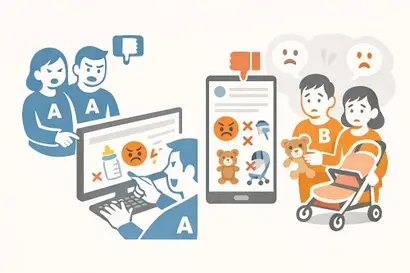
Fourth, although it is a relatively rare type, there are advertisements that secretly slander or criticize competing businesses. In a case where an advertising agency was used to post 274 comments and posts slandering a competitor's baby mat product on 54 internet sites, the KFTC judged this as deceptive advertising and imposed a corrective order along with a penalty of 500 million won. This type often takes the form of online public opinion formation, review manipulation, and viral marketing rather than advertising in the traditional sense. However, in that it substantially influences consumer choice by artificially creating a negative perception of a competing business, it can fully be a problem under the Fair Labeling and Advertising Act.
Summarizing these cases, one can see that unfair advertising is not acknowledged indiscriminately in any advertisement, but is intensively problematic in certain types of actions and areas of interest. Definitive expressions about market-dominant status or superiority without objective basis, 'backdoor advertising' that hides economic interests, advertisements that are definitive without data to support human safety or functionality, and posts or comments that secretly slander competing businesses are particularly representative.
However, the reason why unfair advertising cases are difficult in practice is separate. Primary enforcement authority is concentrated in the KFTC, and as the KFTC also has to handle a large number of cases, it inevitably has to select cases by considering the gravity of the case, policy priorities, and social ripple effects together. Therefore, as a complainant, even if one thinks the advertisement is suspected of being illegal, it is difficult to rule out the possibility that the case will be concluded as 'no suspicion' or 'termination of review procedure' if the KFTC determines that the necessity for policy enforcement is not high or social interest is not significant. Because of these circumstances, in the past, it was not easy to readily advise businesses to actively report a competitor's unfair advertising.
However, the situation has been changing recently. As the domestic online commerce environment has been reorganized around a small number of large platforms, the impact of a platform's internal judgment on the business of a tenant merchant has become much greater than in the past. Now, it has become practically important how a platform evaluates a specific advertisement or sales post, as much as whether the KFTC ultimately imposes sanctions. If a competitor reports the other party's advertisement to the platform, and the platform deletes the advertisement or sales post or restricts exposure according to its own standards, the business activity of the subject business can face significant restrictions in itself. In some cases, platform measures bring about more immediate and fatal results than KFTC sanctions.
In the end, for businesses today, advertising compliance is no longer a matter of post-dispute response, but an ongoing management task directly linked to business continuity. If you are a business that advertises or sells products on an online platform, you must thoroughly check in advance whether there are legal problems with your advertising copy, images, review operation methods, comparative expressions, and expressions related to safety/efficacy. At the same time, it is necessary to continuously monitor the advertisements of competing businesses. This is because advertising disputes have now become a comprehensive risk management issue where platform distribution structures, KFTC enforcement, and in-market competitive strategies are intertwined, rather than a simple dispute over phrases.